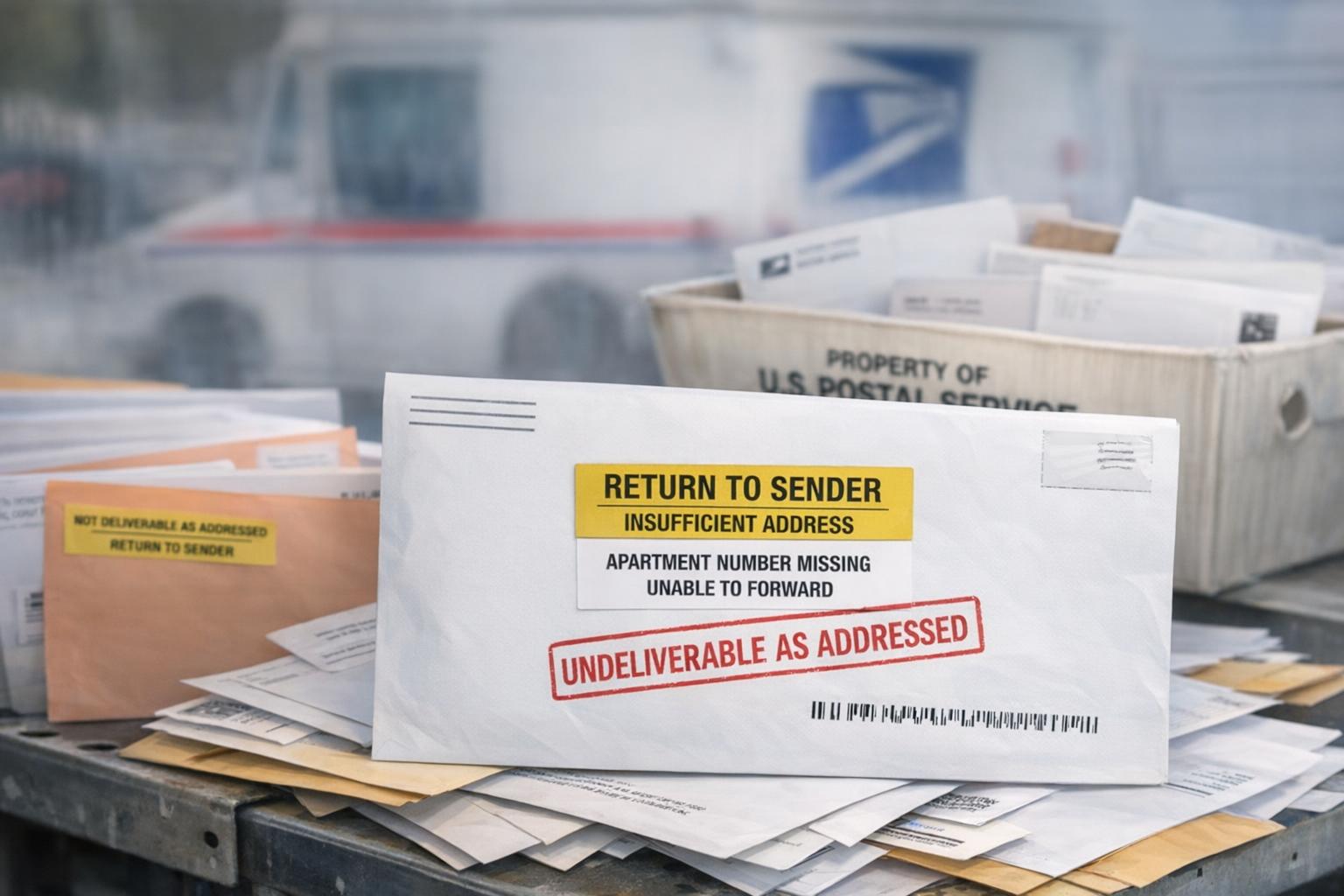
Mail stops matter. A single omitted unit number turns a perfectly stamped package into an unsolvable puzzle for the carrier. This isn’t a mystery — it’s a process failure you can fix before it ever hits the postal system.
## USPS Missing Apartment Number Addressing And Standardization: How Mail Is Routed
When an apartment number is missing, the first thing to understand is that USPS systems try to route mail by what they do know. CASS-certified software standardizes the street line, applies ZIP+4, and checks delivery eligibility. If the software can match a name to a delivery point, great. If not, a human carrier has to decide.
That’s where the phrase “usps missing apartment number addressing and standardization” comes into play in real life. The technology can clean and normalize an address, but it can’t invent a unit number that doesn’t exist in the carrier’s list. So mailers who depend only on auto-fill or sloppy inputs end up pushing unresolved items to the carrier or the local post office.
### Why Apartment Numbers Matter
Apartment numbers are not cosmetic. Delivery points in the USPS database map to very specific physical doors, mailboxes, or front desks. One building can have dozens of delivery points with the same street address and ZIP. Without a unit designator, automation often returns a match to the building but not the delivery point. That opens several paths: the item is delivered to a leasing office, held at the post office, returned to sender, or sometimes left in an insecure place. None of those are great outcomes for a business or a customer.
### What USPS Systems Do
USPS tools do two big things for addresses: they standardize and they validate. Address standardization converts “123 Main Street, Apt. 4B” to the USPS-approved variant like “123 MAIN ST APT 4B” and adds the ZIP+4. Validation checks whether that unit actually exists for that delivery point. Software built around these processes reduces how often a missing apartment number becomes a missing delivery.
But software isn’t magic. If the input lacks a unit, even the best address standardization can only get you so far. That’s why mailers need to pair standardization with business rules that require unit-level data when applicable.
#### CASS And DPV In Practice
Two acronyms matter: CASS and DPV. CASS (Coding Accuracy Support System) helps the mailer get the correct ZIP+4 and standardized format. DPV (Delivery Point Validation) confirms whether the street address and unit combination exist. Use CASS-certified vendors to process lists before printing labels. DPV flags the entries that need human attention so you can stop bad addresses from going into the system.
#### Carrier Practices And On-The-Ground Decisions
Carriers use local knowledge. If they know the building and have access to tenant directories, they might match a name to a unit. If not, they follow policy: try the leasing office, try the mailbox cluster, or return to the post office. For packages, the carrier may leave it at the leasing office or a secure pickup location. For letters, the outcome is less predictable. The carrier’s choice is not a guarantee of accuracy, and it often results in delays.
## Common Outcomes When Mail Has A Missing Apartment Number
You need to plan for the likely outcomes so you can prevent them. Common scenarios include:
– Delivery to building management or leasing office when they accept packages on behalf of residents.
– Held for pickup at the local post office when the mailpiece cannot be matched.
– Returned to sender after multiple failed attempts.
– Misdelivered to the wrong unit when a carrier guesses.
All of those stem from the single problem of a missing apartment number. When you see an increase in returns or “delivered, but not received” complaints, check how checkout forms collect apartment numbers and whether address verification is happening before the label is printed.
### Examples From Real Deliveries
A small online shop sold a lamp to a tenant in a 40-unit building. The buyer entered “201 Elm St” and left the unit field blank. The CASS software returned a ZIP+4 for the building but no DPV confirmation. The carrier, who didn’t know the tenant, dropped the package at the leasing office. The office misplaced it. The seller fought a chargeback. If the checkout system had validated the address and required a unit when the DPV failed, this never would have happened.
Another case: a political campaign mailed voter guides to a condo complex. Mail sorted with automation without unit numbers ended up being bulked and distributed by volunteers at the complex’s lobby. That increased labor and complaints. For high-volume senders, that kind of uncertainty is expensive.
## How Businesses Can Prevent Problems
This is where most companies get it wrong: they treat the unit field as optional. If you ship to apartments at all, make the unit field mandatory. Force validation on submit. Use software that not only standardizes addresses but flags missing apartment numbers and prompts the customer to correct them.
When you hear “usps missing apartment number addressing and standardization” in internal meetings, what people usually mean is: we failed to validate and enforce unit-level addressing before labels were generated. Fix that upstream.
### Checkout And Data Collection
Design your checkout so customers can’t ignore the unit field. Make it clear with examples: “Unit, Apt, or Suite — e.g., Apt 4B.” Auto-format the input and show the standardized result (like 123 MAIN ST APT 4B) before they confirm. If DPV fails, block the order or reach out to confirm. A quick call or email beats a lost parcel.
### Address Verification Tools To Use
Pick a CASS-certified service that also runs DPV. Vendors like USPS APIs, Smarty, Lob, and other address verification providers will clean and validate addresses. For high-volume mailers, integrate address standardization into the order flow so no label prints without a validated delivery point. This reduces returns and chargebacks and keeps carriers from guessing.
## Practical Fixes For Property Managers And Residents
Property managers can reduce headaches too. Keep a current tenant roster at the front desk and with the carrier. Make sure the property’s unit designators match what appears in the USPS database. If a building has unique unit formats, register them so carriers and automation see the same structure. Label mailboxes clearly. These practical steps reduce the times the carrier has to guess.
Residents should write and print their addresses as the USPS prefers. Use “APT” or “STE” followed by the number. Avoid commas and unnecessary punctuation. If you’ve ever had mail return or show up at a neighbor’s unit, check how your address is listed on orders and with the USPS online tools. A lot of lost mail is the result of sloppy input that could have been corrected in the moment.
### When You Receive Mail For Someone Else
If you get mail for another resident, don’t toss it. Deliver it to the leasing office or put it in a secure location where carriers can retrieve it. For packages, note who accepted it and inform the carrier if possible. That small habit reduces disputes and prevents the same address from being flagged as unreliable in business systems.
### What To Do If Your Building Changes
If unit numbers change after renovations or renumbering, file updates with USPS so the delivery point database reflects the new information. That’s especially important with 911 readdressing projects or when developers change floor numbering. Use LACSLink when street names change. Mismatched records cause a lot of DNS for addresses, and the result is more undeliverable mail.
## Operational Steps For Mailers
Operationally, you can reduce issues quickly.
– Run all address lists through CASS and DPV before printing. Flag failures for manual review.
– Make unit fields mandatory for apartment addresses and present examples so customers fill them correctly.
– Use return-label logic that includes verified addresses only. If verification fails, pause fulfillment.
– Train customer support to ask for the unit number when a delivery issue arises and to update the address in your system.
These steps prevent the routine problem of missing apartment data becoming a chronic cost center.
### The Human Factor
Even with automation, people make mistakes. Typing errors, omitted digits, and mistranscribed unit numbers happen. That’s why human checks for flagged addresses remain essential. When your software flags a record, have a real person verify it rather than auto-correcting based on guesswork. One mispelled unit can cause the package to go out the wrong door.
USPS missing apartment number addressing and standardization isn’t a mysterious policy to work around. It’s a predictable failure point with clear technical and human fixes. If you build validation into the customer experience, keep building records aligned with USPS databases, and give carriers the information they need, the number of lost or delayed deliveries drops fast.
Keep mailing simple, enforce unit-level data, and treat address standardization like a basic quality control metric. The next time a customer complains about “delivered but not received,” you’ll have a trail that explains why — and how to stop it.